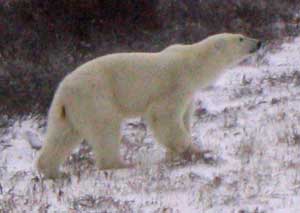
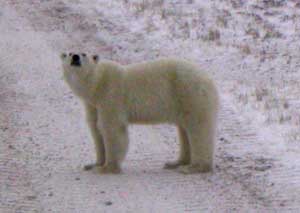
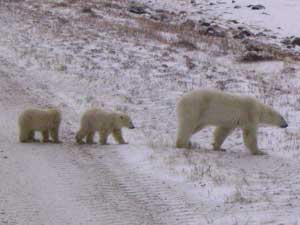
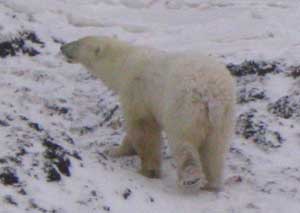
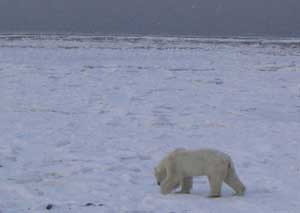
We were fortunate to observe some interaction between the polar bears spread
out along the shoreline. They all seemed to be alert and curious wandering here and there
to see what they could see and sometimes appraoching one another. There were certainly no
fights or other serious confrontations and no vocalizations that we could detect. It was
obvious that size matters. Smaller bears would always give way to larger ones,
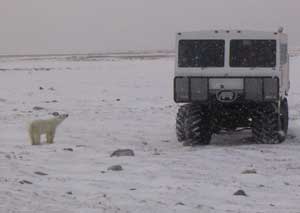
sometimes even abandoning dignity to run away. I got a big kick out of watching
this interaction between a big bear and an enourmous human vehicle. Did I mention
that the people of the Bay love understatement and demonstrate it by calling these
huge vehicles, more like the second story of a house on wheels, buggies.
The bears will sometimes stand up along the side of the vehicles so that they are almost nose to
nose with the delighted people inside. Curiosity, certainly but I wonder if there is
also an element of challenge involved. From the human perspective it certainly is
comforting to be bigger than the bears and above their reach.

“The Biggest Bears Get the Best Toys and Can Play Like Kittens”
It will be a long time before I forget the sight of a huge male rolling on his
back in the ice and snow, playing with a set of cariboo antlers like a kitten might play with a ball
of string. Apparently the biggest bear gets the best toy. We were told that polar
bears normally cannot catch caribou but one was unlucky and the bears got it. There
might not be anything cuter than a snow white young polar bear cub but when even
big tough dominant males can play like kittens, it is hard to deny the charm and
appeal of the lords of the arctic.
Bears lolling about in the ice and snow without any hint of discomfort, indeed with
every indication of enjoyment made me think about adaptations to the harsh climate.
There is an obvious adaptation to cold that humans certainly dont share - or do we?
I remembered our driver's comment earlier in the day. "There is no such thing as bad weather," he said. "Only poor clothing."
It can be argued that ability to make suitable clothing even if we have to kill polar
bears and steal their magnificent fur and hides to cover bodies originally adapted to
tropical climates is a uniquely effective human adaptation to cold. The thick double
layer of fur with an underlayer of more than 4 inches of insulating fat means that the bears can
remain comfortable through out the darkest coldest days of an arctic winter but the
downside is that they can have major problems with overheating - not a good thing
in a warming world or when trying to catch fleet footed caribou.
The adaptations of the bears are obviously to the winter cold and the task of
hunting seals rather than hunting caribou. The relatively small ears and tail relative
to the ancestal brown bear provide additional resistance to heat loss. The long
powerful neck, strong shoulders and curved hook-like claws make it easier to pull big seals
out of the water and up unto the ice. I wondered if the lack of hybernation in the males
that allows them to hunt all winter was also some sort of special adaptation but learned
that it just seems to be an option for bears when there is food available in the winter
time. For instance the grizzly bears at the Calgary zoo are fed in winter and don't
hybernate. Actually hybernation is not an entirely correct description for the state of
torpor and reduced metabolism that allows normal bears, including female polar bears
to survive the winter without food. I understand that they can and will arouse if disturbed,
unkike ground squirels and other true hybernators where metabilism is reduced even farther.
“Sunset in a Frozen Land and Time to Head for Home”
We were still excitedly spotting polar bears as we headed for home but now
was the time when many more questions about polar bears began to pop into mind. For
instance my ears had perked up and I became enormously intrigued by a comment from Les,
our intrepid guide and polar bear expert, that polar bears seem to have separated
from brown bears to become a separate species only about 200 thousand years ago.
It is fun to speculate that an ancestral population of brown bears thrived after
they learned that it was worth while to wander out onto the shore ice in spring in
search of vulnerable seals with newborn pups much like female polar bears do today. It
must have been a shock for the seals when a major predator appeared in an ancient
safe sanctuary, Actually the scenario sounds disturbingly like the notorious Newfoundland
seal hunt when human fishermen go searching for the beatiful soft white valuable coat
of the young harp seal pups born on ice flows drifting from farther north.
The evolutionary time line struck me as highly significant for two reasons. First
of all the earliest known skeletal evidence for an anatomically modern human being
is also 200 years old which puts human beings and polar bears on the same relatively
young evolutionary pathway. We are both children of the ice age. We have both survived
one short interval about 125 thousand years ago when the world was about as
warm as it is now and sea levels were also similar but neither species has ever
experienced an even warmer world. The polar bears are obviously vulnerable to warming
conditions with loss of sea ice. Humans may be considerably less vulnerable but
warning bells should also be ringing loudly about prospects for continuing human
comfort and well being. Maybe caring about polar bears is good practice for caring
about humankind.
Foretunately there are many people who do care. About 10,000 people now travel
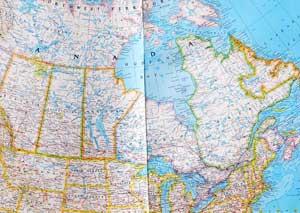
to Churchill Manitoba on the shores of Hudson's Bay every November to visit the bears
waiting for the sea ice to form. Some people who care a lot about polar bears and what they
can teach about ourselves and the world at large include:
Norbert Rossing, an extraordinary German photographer.
Robert Buchanan of Polar Bears International
with his deft corporate touch, Dr Andrew Derocher, Canadian polar bear scientist,
Cassie Seagle and Brendan Cummings,legal experts and environmental activists
with the Center for Biolgical Diversity. The
later is the organization that is pressing to have polar bears recognized as endangered
by climate change under American law which would then have the interesting effect of
requiring the American federal government to take action on climate change.
“More about the Meltdown and Speculation about Noah's Flood”
During the long flight home I kept imagining an ice sheet below our wings
and wondered if I would ever have a chance to make a similar journey into the frozen heart
Antarctica. I also had fun remembering landforms seen on the surface below that
are remnants of the ice age - terminal moraines, eskers, eratics which are boulders
transported hundreds of miles by the slow flow of the ice, huge dry lake beds, broad
valleys that once held big rivers, wetlands and sloughs so important for ducks and geese
with mineral and organic sediments deposited under very different by climate conditions, knob and kettle terain where isolated
patches of ice sheet melted and disintegrtated, big lakes that are tiny remnants of huge
Lake Agassiz, sand dunes and gravel deposits, glacial till which is a churned mixture of
gravel and clay a few feet or a few inches under the thin soil of grasslands and wheat
fields. A vision of ice sheets miles thick was replaced by a lake bigger than many
seas, by broad grasslands teeming with buffalo and finally by the fenced fields,
farms, towns and cities of the Canadian breadbasket.
So what do we know about the melting of the Laurentide ice sheet.
When I went looking for more specific information I found the abstract of a paper by
Anders Carlson that attempts to correlate the rate of retreat of the Laurantide ice sheet
with the rate of rising sea levels. Carlson did his PhD work on the dynamics of the
ice sheet. He claims meltwater pulses that correllate with the relatively rapid retreat
of the Laurentide ice sheet 19, 11.6 and 7.6 thousand years ago raised sea levels by 10-15,
8 and 5 meters repectively. A fourth meltwater peak 14.6 thousand years ago that raised
by -- feet is not associated with obvious retreat of the Laurentide ice sheet. He says
that the early part of the final event when the ice sheet lost a third of its area in
1400 years began with the opening of Hudson's Bay along a calving margin but continued
once the icesheet was land based. I find the statement fairly ominous by analogy to current
conditions in Antarctica even though it can be argued that the change in sea level
and climate was a positive one. For instance, an interesting implication is that
polar bears who make their living on sea ice and not on continental ice sheets could
only have moved into the Hudson's Bay area after about 8000 years ago - about the same
time that early farming communities were spreading across Europe.
An even more dramatic scenario ice loss scenario involving Hudson's Bay is suggested by
Greve and Takahama. On
the basis of a computer model they propose semi-periodic massive discharge of icebergs
into the North Atlantic due to collapses of the ice sheet over Hudson's Bay
and Hudson's Strait when base temperatures reach the pressure melting point so
that very rapid basal sliding on a lubricating sediment layer develops. They propose
that that the mechanism may account for layers of ice-rafted rock and debris found
far and wide on the bottom of the Atlantic that were deposited in so called
Heinrich
Events. Heinrich events correspond to such distant effects as vegetation in Florida
and rainfall in Utah. Wow! There are more than half a dozen Heinrich events known
within the last 75,000 years with the most recent being at 12, and 17 thousand years ago.
This is getting to be serious stuff. Who knew that the ice of Hudson's Bay was so
significant?
During meltdown of the ice sheet huge fresh water lakes formed in a big arc
around the southern margins. Glacial Lake Agassiz, the largest of them all was
named in honour of Louis Agassiz, a contemporary of Darwin, who developed the
first convincing evidence for the ice ages and popularized the concept. Lake Agassiz
covered large parts of Manitoba, Western Ontario, Sakatchewan, North and South Dakota
as well as Minnesota. It has been suggested that changes to drainage patterns and
periodic catatrophic flooding events were important for determining ocean circulation
patterns in the North Atlantic, hence acted as a major contolling factor for regional
climate. When reading about the phenomena I even learned a great new word. Jokulhaup
is an Icelandic word that may be destined to join gysir as the second Icelandic word
to enter the English language. It means glacier burst and adds accumulations of water
under glacial ice to water in glacial lakes as potential sources of flood water.
Turney and Brown argue that the catastrophic draining of Lake Agassiz, presumably
through Hudson's Bay about 8,000 years ago was the most drammatic flood event in the
past 100,000 years. It is thought that there was enough water involved to raise global
ocean levels by more than a meter. Turney speculates that this was the event that
triggered the spread of agriculture across Europe as well as giving rise to the
story of Noah's flood, perhaps through flooding of the Black Sea as
previously suggested by Ryan and Pitman in their 1998 book.
Perhaps surprisingly, large volumes of water have been discovered under the current
ice sheets. The first such discovery was lake Vostok in the center of Antarctica
where the ice is at maximum thickness and drill cores have been recovered that
provide an annual climate record, year by year for the past 400,000 years. Other big
volumes of water are still being discovered as people now know to look for them. Water
under ice sheets has raised concerns about stability of the ice and whether there are areas
where it might suddenly crack and slide. Indeed there is an excellent article on the
current state of the remaining ice sheets written by
Robin Bell in the February 2008,
edition of Scientific American magazine. The excellent
article should be sobering reading for anyone who still believes that it is reaonable to
stonewall, deny or treat climate change with complacency.
I was amazed at first but the discovery of water under the ice sheets does make
sense when you think about it. Ice has the unusual property that it melts under pressure.
It is the meltwater under the blades that makes ice skates so effective. Temperatures
also increase as you dig down into the earth because of heat generated down below so
one should expect the earth itself to warm the ice from below. As described by Robin Bell
summer melt water also finds its way downward through cracks and crevases to help
lubricate the base of ice sheets as is happening in Greenland and west Antarcica today.
So what do we know about Noah's flood and how seriously should we treat the
story?
I am a thorougly secular person with a world view that is informed as well as
can be by reason and science. I am therefore torn between several alternative ways
to think about Noah and his flood. I do retain a deep respect and affection for
the Bible as well as other sacred texts including the Koran that provide such vivid
insights into human attitudes, wisdom, culture, history and conduct. As presented in
Torah, Bible and Koran, Noah's story is a powerfully memorable morality tale. Until
very recently it wouldnt occur to many people to doubt his message that human behavior, or
misbehavior might be enough to cause a change in global climate in the form of
a flood capable of destroying us all. The irony is that now that human behavior in the
form of massive use of the Earth's carbon reserves as fuel has made us fully capable of
causing damgerously disruptive climate change, we seem to be as hard to convince
that it is important to change our ways as were the people of Noah's day.
I remember being incredulous when I first heard the story as a child in Sunday school.
Where did the water come from and where did it go? How did he catch all the animals?
However, I am now inclined to believe that the story is based on real events even
though it may contain elements exaggerated by the art of the
storyteller during preliterate times at the dawn of history before it was written
in sacred texts. The story is certainly far to much fun and far to portentiously insightful
to glibbly dismiss it out of hand. I am curious though about how much of the story can be
relied on to provide complimentary information about real events when combined with
the picture of the past being revealed by science. Is this an instance where religions
and science converge to provide deeper, richer insights and a clearer warning than either
could alone?
The incredible thing is that there actually was a global flood and significant extinction
events associated with it although there is no evidence of any severe bottle neck
in human genetics as would be implied if only one family managed to survive. For instance
most of the large ice age animals of North America including giant sloth, saber toothed
tigers, and mammoths disappeared forever under conditions when the world was warming. It
is now clear that the water came from melting of the northern ice sheets and it never
went away. The meltdown was apparantly under the influence of a subtle changes in global
heat balance, a small forcing effect sustained for many years caused by the dynamics of
the Earth's orbit as first described Milan Milankovich and magnified by "positive
feed-back" factors. One example of a positive feed-back effect that is currently the
source of much concern is directly related to the well being of the polar bears. Sea ice
and snow are white with a high albedo meaning that they reflect a lot of the energy
from the sun directly back out into space contributing to cooling the world. On the other
hand open water has a low albedo, meaning that it absorbs much of the energy from the sun
contributing to further warming as the world warms.
The scientific viewpoint is that it took about 15,000 years for sea levels to rise
400 feet before stabilizing about 5,500 years ago seems much to slow to fit with the
dramma of the biblcal account. Known surges in the rate of meltdown or flow
ice and water into the oceans must be considered but even these surges generally
happened over time scales of more than a thousand years. Even astonishing special events
like the final draining of glacial Lake Agassiz through Hudson's Bay where perhaps a
meter was added to the global sea level within months seems less than Biblical. It is
therefore easy to understand the tendency to want to identify drammatic local flooding
events like the flooding of the Black Sea as a possible basis for Noah's story.
The flooding of the Black Sea basin must have been a totally incredible event. My
personal inclination, however, is to suggest that there must have been any number highly
traumatic situations where changing climate conditions and the slow but unstoppable
rise in sea level, sometimes triggered by heavy rains and local flooding would force
people to either move and adapt or die. Can we assume that much of the world's population
then as now also lived fairly close to the sea including occupation of the deltas and
flood plains of major river systems? Is it reasonable to suggest that perceptive people of
the times, like Noah would notice that ancient holy places and temples near the sea
were becoming more and more susceptible to annual floods, generation by generation?
Perhaps there even might have been a tradition of marking flood levels on the walls of
ancient temples that seemed to be slowly subsiding into the mud of the plains even
as the sea moved farther and farther up the river.
It seems reasonable to infer from scriptural descriptions that Noah was a devout,
influential member of a fairly sophisticated society. Furthermore his society had
domestic animals
and the ability to make fairly large sea going vessels and provision them for extended
voyages. Ships imply maritime trade and substantial trading centers along seacoasts or
coastal rivers. Is it also reasonable to believe that such a society already existed
7,400 to 9,000 years ago when the ice shelves of Hudson's Bay collapsed, when the
Laurentide ice Sheet was making its final rapid retreat and when Lake Agassiz suddenly
drained? There are some interesting issues here with the timeline because many historians
and archaeologists would seriously doubt the existance of such a sophisticated society
at such an early date. There are also people from some of the faith communities that
still stongly believe that the whole world isn't even that old. However, the age of
the world has been reliably established to be about 4.6 billion years based on study
of the decay properties of uranium. This means that the time since the meltdown of the
Laurentide Ice Sheet is a blink of the eye in terms of the age of the world but still
seems to be ancient when compared with known human history.
Most authorities trace the origins of civilization, meaning the building of early
cities, to the time of the Summerians
of Mesopotamia and perhaps contemporaries in the Nile, Indus and Yangtse Valleys
starting in the late sixth or early fifth millenium BCE and thus about 7,000 years
ago. The date given for the origins of ERidu, is said to be about 4,900 BCE hence 6,900 years ago. The archaeological site
identified as Eridu is known to have had mud-brick and reed buildings including raised
temples and irrigation agriculture characterized by building of canals. The technical
and social sophistication doesnt seem inconsistent with Noah's story even assuming
Noah came from a still slightly older time. It is also noteworthy that the Summerians
had a flood story of their own associated with the
Legend of Gilgamesh,
an early hero king who may or may not have been mythical.
When I close my eyes and give free reign to the imagination I find that it isnt
a big stretch to imagine an even earlier phase of civilization pre-dating Eridu but
still hidden beneath either the waves of the Persian Gulf and/or the
accumulating sediments of coastal Iraq. It is known that Jerico of biblical fame
was already a prosperous neolithic farming community within the appropriate
time frame. Catal Hoyuk, near
---- on Turkey's Anatolian plateau is a remarkably well preserved neolithic
farming community. The site has been extensively studied and provides invaluable
insight into human culture and technology during what may well be Noah's time.
The people were not yet using metal but did have quite beatiful pottery though made
without a potters wheel. They also had baskets and woven textiles. They were growing
grains including wheat and barley. Domestic sheep and goats were raised. A nearby
volcano provided a plentiful supply of obsidian for making sharp stone tools.
There were wild cattle and pigs in the region and domestication of these may also
have been well underway. The town supported perhaps 5 to 10 thousand people so social
structure must have been fairly complex. Buildings made of mud brick were built
close together like a honeycomb with access through the roof using ladders. There
was a small river beween two separate habitation areas and marshland round about
where geese and ducks would have been plentiful at least during part of the year.
I find myself imagining a wooden bridge built over the river and young men fishing. There
is inevitably a strong desire to visit the place as it still exists to try to get
as better feeling for how the town must have looked during the days when the place was
alive with happy children, sheep, goats and industrious people.
Is it reasonable to presume that contemporaries of the farmers of Jerico and Catal
Hoyuk living near the sea and thus more vulnerable to flooding might have been capable of
building even bigger towns and cities as well as sea worthy ships? We know
nothing about coastal towns of the day. Surprisingly, it possible to at least speculate
a little about ships? I understand that there is strong evidence that the early
Egyptians, Summerians etc built watercraft, both large and small by tying bundles
of reeds together. One advantage is that you simply use more bundles to make bigger
boats.
Thor Heyerdahl the Norwegian adventurer of Kon Tiki fame was convinced that reed boats
were one of the keys to ancient oceanic exploration and trading prowess. He used
pictures in Egyptian tombs plus the traditional reed boat building knowledge of
people from Lake Chad in central Africa, Lake Titicaca in Bolivia and marsh lands
of Iraq to build several large reed boats. Heyerdahl then tested the
seaworthiness of such craft by sailing across both the Atlantic and the Indian Oceans.
Reed with bitumen and wood is specifically mentioned in scripture as one of the building
materials for Noah's ark.
Goodness gracious! To my considerable surprise a feasible
picture is emerging that would seem to link the collapse of the ice of the Hudson's Bay
region with the exploits of old Noah. Even the strange business about the flood water
covering the highest peaks may have an obvious explanation. Any sailor can describe
the effect of mountains apparantly dropping below the horizon as one goes out to sea. To
experience waters that seem to cover the whole world anyone can simply enjoy an ocean
cruise. The effect is simply because the world is round but the ancients generally
didn't know that as far as we are aware at least until the time of the Greeks who
sucessfully attempted to measure the diameter of the world.
We can be very sure that the waters didn't really cover the highest peaks. One of
the bed-rock corner stones of modern science is the conservation of energy with
mass recognized as a concentrated form of energy. There are no exceptions so
massive volumes of water simply cannot be conjured out of nowhere and then disappear
again.
Yes I know about the fun of finding sea shells and other marine fossils on the
top of mountains. That is a whole different fascinating story featuring a time line
much longer than the few thousands of years since the collapse of the Laurantide Ice Sheet
and development of the roots of human civilization. The 4.6 billion year age of the
our dynamic Earth as known to geologists has seen the formation and continuing drift
of continents, the repeated opening and closing of oceans and the rise and fall of
many mighty mountain chains. I get the feeling that all of geological time has to be
pondered and understood in order to really appreciate the concept of climate, climate
change and the various factors that determine global temperatures. I find it
totally remarkable the thermal control factors have allowed big swings in global
temperatures throughout geological time yet have managed to maintain global temperatures
within the fairly narrow range where diverse life forms can grow and thrive. I do think
that it should concern us all that we as human beings have been innocently,
and now not so innocently, monkeying with the global thermostat. How can we now
continue to believe that there will not be serious consequences?
I am obviously not the first person to make to make the suggestion that the roots of
civilzation must be hidden beheath the sea. Aside from Noah, who can forget
Greek legend of Atlantis sinking beneath the sea? There is a popular notion that
Thera, a volcanic island in the Agean destroyed by a eruption is the basis for
the Atalantis legend but it seems to me that changes in global sea level provides an
attractive alternative. Graham Hancock
made a provocative case for truely ancient origins of Egypt's famous sphinx -
a time when the local climate was much more wet - perhaps 10,500 BCE based on
orientations and sightlines to significant astronomical objects. I am intriqued
that this date is even older than the time of the final surge in sea level
associated with the meltdown of the continental ice around Hudson's Bay. I find that
that I am not inclined to try to dismiss the astonishing claim. Indeed, it does make
you wonder what fragile hints form the far past and treasures will eventually
be found beneath old Cairo. Hancock has actually made a career of looking under the
sea in far flung parts of the world, from Malta in the Mediteranean to the coasts
of India and China, for traces of ancient roots of civilizations. His adventures
and speculations are all good fun and a great read. Given the timing and complexity
of the meltdown of the continental ice of Hudson's Bay I am starting to believe
that eventually such traces will eventually be found.
When I close my eyes I can imagine old Noah shouting at me. "Fool" he is saying. "We
only tried to save the best breeding stock from the domestic herds so we could build a
new life but don't you dare let any of the animals die! I didn't know about polar bears
but you do. Don't you dare let them die!"
So what is to be done? My wife and I are long time supporters of the
Canadian Parks and Wilderness Society (CPAWS) but I
think that I will have to take Noah's command to heart and extend support to other
conservation groups as well. The World Wildlife Fund
certainly deserves support for highly meritorious efforts. I would be extremely pleased if
others might also be willing to also join the cause.